Showing posts with label writing. Show all posts

Thursday, January 9, 2025

The online media landscape (and the looming drought for creatives)

From a young age, I always wanted to be a writer and/or an artist. Like most kids, I went through a variety of 'dream careers', but those two were always on the list, even if it was part time in addition to having a day job. I also always knew that my chances of 'making it big' in either of those careers were slim - as they rely almost as much on luck as they do on talent or skill, and who you know is often as important as what you know - but even until a few years ago, it seemed like a creative career was at least somewhat achievable, as long as I put in the time and effort to hone my skills and actually finish a project.

Unfortunately, the creative industry has changed a lot in the last few of years. Most of the following examples in this post are from an author's perspective, but many are just as applicable to artists in a lot of ways.

Once upon a time, if you were lucky enough to get your book published through a traditional publisher, they would not only print and distribute the book, they would also market it for you. The channels they advertised in obviously changed over the years - from paper catalogues to websites and finally to social media in the last decade or so - but it was still considered the publisher's job to sell your book. They would keep a greater percentage of the profit from sales of your book, but they were also the ones doing the work and taking the financial risk, so that was at least somewhat reasonable.

But at some point in the last 5-10 years, that responsibility seems to have been shifted onto the author. Unless you're one of a very few, very big names (eg. Stephen King or N. K. Jemisin big), your publisher is unlike to do much advertising on your behalf aside from the odd Tweet, which is likely to be as effective as shouting into a well. Brian Kirby did a thorough comparison of engagement that various publishers were getting on Twitter versus Bluesky for promotional posts they made. They found that even with only about a fraction of the follower numbers, the number of likes and ReTweets the publishers got on Bluesky were significantly higher than they were getting on the same posts on Twitter; in one case, the only engagement a Tweet got was from the author of the book being promoted.

Some publishers will apparently take it a step further and blame the author for not promoting their book if it happens to have poor sales. In other words, they expect you to do their job for them and pay them for the privilege of doing it. Not only that, but some publishers won't even touch you if you don't already have a huge social media following, which makes being a writer feel a bit like being a job seeker who can't get a job because they don't have experience and they can't get experience because no one will give them a job.

So it seems like these days if you want to make it as a writer (or an artist), you need to have a good social media presence. You need to be a promoter and advertiser in addition to being a writer (and probably in addition to your day job as well, because the vast majority of us can't afford to write full-time) and have the skills to market your product to your intended readers. The problem with that is that the same social media sites you have to rely on to find your audience seem to be hell bent on alienating as many users as possible.

CultureCrave posted on Bluesky (via Financial Times, though going direct to the link seems to hit a paywall) that Meta plans to fill Facebook and Instagram with AI generated users*, which to me seems akin to a sports centre manager announcing that he's going to start shitting in the swimming pool as if that's a good thing. Meta claimed they were doing this to "make their apps more engaging" and attract more users to the platform, even though filling the apps with bots will have the opposite effect. It's bad enough seeing the deluge of AI-generated slop posted by accounts run by humans (not just because of the poor quality but because a lot of it is just downright wrong) added to the existing slurry of advertising spam and constant harassment to follow pages or join groups I'm not even interested in, but if the accounts themselves aren't even real, what is the point of interacting with them? What is the point of staying on that platform? While many users will stay out of apathy or because these platforms are the easiest or only way for them to stay in touch with certain friends or family members, a lot will simply leave. Some might end up on the shores of some other social media platform (where it's going to be difficult to start building up connections again, especially if your friends and followers scatter to multiple different platforms), while others will just vanish outright; I left Twitter** along with many other users as part of last year's mass exodus, and although I did find some of my Twitter friends elsewhere, many of them have apparently disappeared into the ether.

I've already noticed the effect of this social media attrition even on my own small pages. I run dedicated profiles for my art on Facebook and Instagram (and on Twitter, before I nuked all my posts), and once upon a time, when I'd post a new art supply review or demonstration, I'd get at least 10-15 likes on each (not much in the grand scheme of things, of course, but at least I could see that my work had some reach). Now I'm lucky to get 2-3 likes, and those are usually from the same handful of friends who like all my posts. If my already-established public pages are facing such a significant drop in views, it's going to be so much harder for a creative person setting up a new page and trying to build up an audience from scratch. And at this stage, there aren't really any viable alternatives; sure, you can set up your own website (or even a blog), but how do you get people to find it?

As a creative person it's actually really goddamn depressing knowing that even if I manage to finish writing my novel, in order to get anywhere, I'll be forced to do my own marketing and advertising because the people whose job that actually is (ie. publishers) don't do it anymore, which means having to rely on social media that is becoming more and more unusable because the companies that own these sites are just pumping them full of spambots and AI trash (like this and this) and letting abuse and hateful rhetoric against minorities flourish***, thereby driving the actual audience away.

Maybe one day things improve for artists and writers (and other creatives), but I fear things will keep getting worse before they get better. I can't help but wonder how many awesome books and how many beautiful drawings and paintings we won't get to see because they got drowned out by the sea of ChatGPT and MidJourney trash or because publishers wouldn't even give them a chance. I don't know a single sensible person who actually welcomes all this AI rubbish in place of human-made art and stories (as I've posted before, it's not just poisoning creativity but also people's ability to think critically), so I just hope there's enough of a pushback against it that we as a society can prioritise real imagination. As for traditional publisher's failing to do their jobs, I know there are self-publishing options and the ability to create eBooks, but as with having your own website, how do you market your book to an audience that isn't there?

*Sure, Meta has since deleted these AI-generated profiles in response to the overwhelming backlash against them, but if you believe they won't try something similar as soon as they get half a chance, then I have a bridge to sell you...

**I still have an account there to maintain my username, but I deleted all of my posts and removed the app from my phone and I no longer open the site.

***[content warning for this footnote; threat of sexual assault] Let's be honest, they've always done this last one - Twitter once told me that someone threatening to rape me with a broken bottle for saying I didn't care for Steven Moffat as a Doctor Who showrunner "didn't violate their community standards", and Facebook have repeatedly refused to remove pages encouraging violence against women (though they did put a year-long warning on my account for "threats of violence" when I joked to a friend about "nuking" my account!) - but now many social media companies aren't even pretending to care about the safety of their users anymore, with Meta now explicitly allowing abuse and harassment of women and queer people and removing their fact-checking system, Twitter being taken over by a giant attention-seeking toddler who supports a convicted rapist and felon and allows misinformation to run rampant and BlueSky refusing to remove a user known for harassing trans people (as well as other toxic behaviour).

Tuesday, December 31, 2024

Reaching the end of 2024 (and the halfway mark of my novel)

In a few hours, people will start letting off the fireworks that signal the transition into a new year, so as I get ready to go out with my friends for wild drunken parties sit on my couch in my pyjamas with a cup of tea, I thought I'd evaluate the year just gone.

Finishing my PhD was something that cropped up on my "New Year's Resolutions" lists pretty much every year for about the last 5-6 years, and that trend continued this year. However this year I finally did actually finish it, so the knowledge I can forever delete that resolution from my list feels like a weight has been lifted, especially given there were several years I doubted that getting my doctorate was even possible.

Once I'd submitted and finalised my thesis revisions, I had more time and energy for my creative pursuits. I was able to do several paintings in the space of a month (as opposed to being lucky to do one a year), as well as some demonstration posts and articles on my art blog. But best of all, I started writing creatively again.

Sure, it took me several months from the time of submitting my thesis to the time I started adding to my novel word count, and progress in the first couple of months was extremely slow (there were a lot of days of just opening my novel documents, staring at them for several hours and then closing them again), but once I hit my stride, it was like the floodgates had opened.

The progress I made wasn't just in terms of raw word count. As I was writing the original outline more than a decade ago, I envisioned it as a novella that would be around 40,000-50,000 when it was finished, but even before I got too busy with my PhD to keep writing, I felt like I'd hit a wall and progress on the WIP stalled. Once I picked up the story again earlier this year, I quickly realised that if I did tell the story in that many words, it would be rushed and incomplete. I began to rework the outline, adding details and expanding some sections, and realised the final word count is more likely to be between 70,000 and 80,000 words. Part of me hated the fact the story was expanding because it made me realise it would take longer to write, but at the same time, it felt like I was unlocking something that would make it possible to write the story at all.

I'd hoped to hit the 50% point of my novel before 2025 rolled in, but I didn't quite get there. I'm not too worried, though, because I still managed to add 13,000 words in the last five months of the year (incidentally, I wrote the final 13,000 words of my PhD thesis in the last five months before my submission deadline, so at least I'm consistent, I guess?).

I'm not going to make formal 'resolutions' (eg. "I will do XYZ!") this year, because I inevitably feel like crap when I don't manage to achieve them. What I am going to do is make a list of things I hope to achieve but won't beat myself up over them if circumstances beyond my control (eg. health issues) prevent me from achieving them. Some of these will be creativity-related, but some will be more general.

  1. Finish a first draft of my novel: Like 'finish my PhD', this has been a long term resident on my lists of resolutions, but for the first time in ages, it feels like it's within reach. I've added a third of the current word count in under half a year, so even if I don't completely finish it by the end of 2025, I reckon I'll be pretty close. Once I start teaching again I won't be able to maintain the writing momentum I've managed for the last month or so with no work commitments, but I should be able to set aside one full day a month (aside from assignment marking weeks) just for writing.
  2. Get a paper accepted into a conference or journal: I've started the process of writing a paper based on my thesis with help from my supervisor, and we're aiming to get it into a conference that runs in May next year. That being said, the acceptance rate for that conference is relatively low, so failing that, we'll try a few other places. Even if it doesn't get accepted next year, I'd like to have the paper in a state where I can try other avenues of submission.
  3. Improve my diet and fitness habits: This is something I've been trying to do on and off, with varying levels of success. The diet part was relatively easy (I actually enjoy eating healthy food, and as I've cut out junk food, I've found myself wanting it less and less, so I tend not to eat it even when I have the opportunity), but maintaining a consistent exercise regime is a struggle. Previously I've tried going to the gym 3-4 times a week and ended up losing motivation after a week of illness meant I only went once a week, so for now I'm going to aim for twice a week, plus another two days a week of gentle exercise at home (walking the dog or using the elliptical trainer). If I can maintain that for a few months, then I'll increase my gym workouts to 3-4 a week. One thing I really need to change is my mindset of "I didn't reach my goals this week, might as well give up". I know it's not a productive mindset, but it's how my mind naturally works. Instead I want to get into the mindset of "One workout a week is still better than none".
  4. Do more plein air painting: This sort of follows on from my previous item, but aside from one painting I did a couple of weeks ago, pretty much all of my art has been done at my desk in my lounge room. At least once a month, I want to go somewhere with nice landscape scenery and do a painting from location. This will require some level of physical fitness, but it will benefit both my mind and body, so while I expect my first few plein air outings will be wrought with problems and may not even result in a presentable piece of art, it will be worth it in the long run. To start with, it'll mostly be local places (like the creek on the other side of town where we walk the dog, or maybe the beach near where my Nan used to live), but eventually I'd like to start going on some of the plein air painting holidays organised by professional artists in more far-flung and interesting locations.
  5. Figure out how to sell my art originals: I have done quite a few paintings and drawings over the years, and while some have ended up in the recycling bin, I still have a reasonable stack of art in my cupboard, which I expect will grow as I find more time for making art this year. I have managed to sell a few paintings to friends through my personal social media pages, but I want to set up some sort of storefront where I can sell my art to a wider audience. I do have sites on RedBubble and Society6 where people can buy products with my art printed on it, but I make very few sales there (and the few I do make mostly end up in the pocket of those sites), but finding a reliable way to sell the physical original copy will be a challenge (not just avoiding horrendous fees like on eBay and Etsy, but I will also need to figure out how to weed out scammers).

DASW Word Count: 35,468

A progress bar showing 35,468 words out of 75,000.

Progress graphic generated by Visual Percentage Calculator and edited in Pixlr.

Tuesday, November 19, 2024

Losing the plot (or at least untangling it a bit)

Over the last month or so, I haven't done as much writing on my actual manuscript as I would have liked thanks to assignment marking deadlines, but I have been making some significant changes to the novel outline. One issue I had originally was that there were parts of the outline where I didn't really have a good idea of what I wanted to happen. As a result, these sections were either rushed and lacked adequate detail, or had 'placeholder' events that were there just to get the story from point A to point B regardless of whether those events made sense. In a similar vein - as I've complained about before - there were multiple instances of thing happening Because The Author Needs Them To rather than because they were logical things the characters would do.

After a lot of staring vacantly at my computer screen and a lot of scribbling on post-it notes, I moved some things around and had to add another chapter to try to fix those problems, only to discover that something else that was important doesn't really fit anymore. It was a bit like playing Jenga, with the whole thing constantly threatening to come crashing down around my ears, but eventually I managed to remove most of those rushed or illogical events from the story. For the events I previously didn't really have a logical explanation for or the explanation was ridiculous (for example, the event happening being technically possible but the level of chance/luck required for it to happen was astronomical), I was able to reconsider some of the characters' motivations and behaviour and how other characters would respond to that, which meant I could then say "Here is why Character A might do X, which means that now Y happening has gone from statistically implausible to reasonably likely".

There are still a few remaining elements where I haven't come up with a good explanation for them yet. Mostly surrounding the backstory of the antagonist, a powerful supernatural being who is both a ruler of her realm and a prisoner of it. The reader and/or the main characters may not ever learn the full reasons behind why something is happening in the story, and that's okay, but as the author, *I* still need to know why it's happening, so that I can make the bits the readers and characters do learn at least sound plausible.

All of this restructuring has resulted in some bits I previously liked being significantly reduced or cut out entirely, but other sections have been expanded, and I think the story overall is stronger for it. I certainly think it flows much better than it did previously. The manuscript is over 30,000 words now, and my estimate from eyeballing the word counts for the existing chapters is that the final product will end up at around 75,000 words, so it's looking less like a novella and more like an actual novel.

Friday, October 11, 2024

Writing for a willing audience

Several months ago in an online chat server for my teacher friends, someone asked what everyone was up to that day, and I mentioned that I was "staring at my novel manuscript and trying to make myself write but knowing I will just stare at it for a few hours and then go back to dicking around on the internet". A couple of friends expressed interest in the story, so after re-reading the prologue and first chapter manuscripts which I had finished in the early 2010s (to make sure there were no egregious issues), I posted them in the chat. Those who read it responded favourably, and with that little dopamine hit, I went about my day.

But as I continued to shitpost on social media or whatever I was doing, I kept mulling over the chapters I'd submitted. I didn't make a conscious decision to do it, but every now and then I'd think, "This bit would be better if that character did this instead of that" or "I could reword this section slightly and then cut out a big chunk in a later section". I started off occasionally opening my novel manuscript to make those changes before closing it and going back to time-wasting, but gradually I found myself focusing only on my writing and completely ignoring everything else.

At first, the revisions I was making were fairly minor, mostly consisting of copy editing and sentence restructuring. As time went on, the revisions became more substantial. In addition to improving some of the existing work, I was able to add about another thousand words to my total, which hadn't really budged for the better part of a decade.

Then I received the Examiners' Reports for my thesis and had to focus my attention on that for about a month, during which time I injured my right wrist. In addition to being painful, this made everything take three times as long as it normally would. Between thesis revisions, assignment marking and novel writing, something had to give, and as frustrating as it was to stop writing when I was starting to get so many new ideas, I had to shelve my novel. Even once I submitted my thesis revisions and finished marking that batch of assignments, I had to spend a few weeks resting my wrist.

As of about a week ago, I was able to start writing again, and it was like a switch had been flipped. Gaps I'd left in my chapters in progress because I couldn't think how to bridge them when I originally wrote them were finally filled. As mentioned in an earlier post, I had numerous instances in my outline of things happening because I needed it to happen for the story rather than because it was a plausible or logical thing to happen, or things which I needed to happen in a later chapter but which couldn't happen because of something I'd written in an early chapter. For many of these, I suddenly had ideas to overcome these plotholes and come up with realistic explanations for why these things were happening. There were even some passages that I had originally thought were okay, but when I looked at them more recently with the benefit of more maturity, knowledge and experience, realised they were problematic and was able to rewrite them to remove the cliches and stereotypes and make the story stronger. In the last week, I've added another 4,000 words to my manuscript, and I still feel like I have plenty of momentum.

I'm sure I'll hit another wall soon enough, but until then I'm enjoying the process of getting the story out and watching the word count go up. Even though I haven't and probably won't show the later chapters to anyone for a while, it seems that having a few people express interest in the story was enough to show me that it does have potential and kickstart me into working on it again.

And now that I am finally a Doctor as of yesterday, there's one less thing to get in the way of me working on my creative projects.

DASW Word Count: 27,021

Wednesday, September 11, 2024

Managing ideas that turn up unannounced

I don't know about other artists and writers, but I find that I'm most likely to get ideas for my creative projects when I'm least able to act on them. You say to yourself, "I'll write it down later" but more often that not, you'll either forget about it completely or have that frustrating feeling of knowing you had a good idea but now it's gone.

One of the most common times for me to get ideas is at around 2 or 3 in the morning, when I'm in that foggy area between sleeping and waking. I do try to keep some sticky notes and a pen next to my bed for when I have these midnight ideas, or failing that, I can write something in the notes app on my phone. This doesn't always help, though; my sleepy brain is not good at communicating with my awake brain, and more often than not, the incoherent ravings I leave for myself are beyond my ability to decipher. Below is an example of an actual "idea" I found one morning when I woke up (and no, I still don't know what it means several months later). That being said, I have ended up with some truly bizarre notes that I was actually able to figure out the meaning of, so it's still worth a try.

A phone with the notes app open, showing text that says "Jimmy Barnes cat but a jelly fish".

So, there's probably not a lot I can do about the midnight ideas, but I also often get ideas during the day when I'm doing academic work, like marking assignments or revising my thesis (which I should be doing right now SHUT UP DON'T JUDGE ME), or even sometimes when I'm working on a different creative project. For those random ideas, I carry a pocket-sized notepad when I'm away from my computer, and for when I am at my desk, I have a Word document set up for getting the ideas down as fast as possible. It's important to note that these documents are not designed for ideas that are eloquently written or painstakingly crafted into intelligent prose. No, they are for a quick and ugly dump of whatever ideas are rattling around in my brain so I can get them out of my head and move on with whatever I'm supposed to be doing. One of my friends in my writing course many years ago coined the term "brain poo" to describe this process of essentially crapping out ideas at speed, and I liked it so much I still use it today.

The benefit of this process is that you don't have to worry about if the ideas is good or not, or try to figure out how to express it. That's Future You's problem. Once you get the bones of the idea down on paper (or on a blank Word doc), that niggling fear of "what if I forget the idea?" is gone. Later on when you have time, you can open that document and see if the idea is workable (whether it be for a new project or for something you're currently working on). If it is, you can sit down and start expanding on it. If it's not, you can just bin it.

Unfortunately it doesn't help with that itch to just write the story, but it does at least ensure you have some fuel to work with next time you do have the chance to sit down in front of your WIP.

Thursday, September 5, 2024

NaNoWriM-Oh no: Why AI is bad for creativity (and for everything else)

At the start of September, NaNoWriMo made clear their position on the use of AI in writing, and though it seems they've edited the wording slightly since the furore around their statement began, they still seem oblivious to why people are so opposed to their views.

Before I launch into my own anti-NaNoWriMo rant, allow me to provide some background information:

I am an academic, and a teacher at a university. I teach a variety of units, but there is one unit in particular that I have taught for more than a decade, both as a tutor and as a lecturer (I have also developed and run an online version of the unit for my university's online-only course branch). So I think it's fair to say I have the experience to recognise trends and patterns in the student cohorts in terms of their achievements.

Based on what I have seen, I firmly believe that the introduction of AI tools such as ChatGPT will set back humanity's development and advancement by a decade or two. When we set a task in class for students, instead of engaging with one another and discussing the concepts, they open up ChatGPT and paste the tutorial instructions into it, and when we ask them to share the answers, they just regurgitate the slush ChatGPT spat out. The problem is that while ChatGPT is very good at producing content that sounds reasonable, it is not good at nuanced thinking or self-reflection or considering scenarios that might fall outside the norm. No matter how many times we pull students up on their incomplete or in many cases incorrect or inappropriate answers that they got from ChatGPT, they would still rather rely on a flawed system than try to apply the content or principles. In other words, they seem to have lost the ability to think for themselves (and now there's research that backs this up). This isn't just a problem in education but has wider implications for society as a whole.

This is particularly evident when it comes time for me (and my colleagues) to mark assignments. Because many of the students did not actually complete the activities in class, they didn't learn the skills required to complete the assignment tasks properly, which means that instead of meaningful deliverables and insightful analysis of what they have done, we end up with pages and pages of word vomit that use a lot of big and fancy words (if I took a shot every time I saw the word "meticulous" in an assignment that was very clearly not done meticulously, I would have liver damage) but don't actually say anything of any substance or value. It's been a few semesters since ChatGPT became widely accessible and when I say that the average student marks have dropped by a full grade since that point, I am not exaggerating.

So when I saw that NaNoWriMo had come out in support of people using AI in their 'writing', I wasn't particularly surprised because of how problematic they've been in recent years (and I'd already decided I wasn't going to participate again because of the appalling way they handled those incidents), but I was disgusted.

I've linked to their statement at the top of this post, but I want to focus on three sections in particular that stood out to me.

"NaNoWriMo does not explicitly support any specific approach to writing, nor does it explicitly condemn any approach, including the use of AI... We fulfill our mission by supporting the humans doing the writing."

Aside from how pathetic and wishy-washy this comment is, it's contradictory and also demonstrates a lack of understanding about what AI actually is, and how it works. Content generated by ChatGPT and similar AI tools doesn't just magically come from nowhere. It is built on stolen work. Actual artists and writers created this original content, and ChatGPT just chews it up and spits it out without providing any acknowledgement or compensation to the human beings without whose work it couldn't exist. You can't claim to "support the humans doing the writing" when you allow or encourage the use of a tool that does the exact opposite of supporting actual human creators.

On a side note: Writers who complain on social media about your writing being fed into AI but then include AI-generated 'art' in your social media posts? You are part of the problem. You cannot claim to be upset about your work being stolen when you are turning around and doing the exact same thing to other creatives.

"We believe that to categorically condemn AI would be to ignore classist and ableist issues surrounding the use of the technology, and that questions around the use of AI tie to questions around privilege."

This bit actually made me snort. Implying that disabled or poor people can't write without AI to help them is far more condescending and ableist/classist than criticising the use of Artificial Idiocy ever could be. In fact, the poor or disabled people NaNoWriMo claims to want to support in their ridiculous statement are also among the most likely to be disadvantaged by the existence of these AI 'tools', because they're far less likely to have the resources (time, energy, money) to fight back when their work is stolen and passed off as the magnum opus of some pretentious wanker who thinks they're going to be the next Hemingway just because they mashed a few buttons in ChatGPT. Frankly, if you can't write stories without using a machine to steal bits of other people's stories for you, that's not a case of "ableism" or "classism". That just means you're not fit to be a writer.

"It's healthy for writers to be curious about what's new and forthcoming, and what might impact their career space or their pursuit of the craft."

At this point, writers who genuinely care about the craft have a pretty solid understanding of how AI might impact their career space. Spoiler: It's not good. I follow many artists and writers on various social media sites, and I have not seen a single positive comment about AI from any of them. It's not just that AI steals the content from the original creators without paying them. As with my students, many people would apparently rather have something crap but fast and easy than put in time and effort or pay for something that is actually worthwhile. AI 'art' is the fast food equivalent of creativity: Sure, you can have it quickly, but it has no value and you'd regret consuming it if you actually thought about it for more than a minute or two. The increase in people turning to AI to pretend to make things for them means the people who actually make the art or write the stories you love aren't getting paid, and if they're not getting paid, the industry is no longer sustainable for them, so they will just stop creating; that means less new content for fans.

And it's not just the financial impact on the creators. True creativity is what differentiates us from machines. The need to make something that evokes feelings and provokes reflection is something that only humans have. The desire to grow and improve and become good at something is what lays out the pathway for a kid scribbling away in their notebook to practice and learn and eventually make something that only they could have made, because it has come from their experiences and their thoughts and their emotions and is, in some way, a window into their soul. If we take the soul out of art, what's the point?

Anyway, it's disappointing that an organisation that used to be a fun and engaging way for writers to communicate with one another has turned into *gestures vaguely at the festering corpse of NaNoWriMo's integrity* whatever this is, but I think it is also now pretty clear that NaNoWriMo is no longer worth your time or money.

I just deleted my NaNoWriMo account (which I should have done years ago but just never got around to it), and I suggest you do as well.

EDIT: Some arguments I frequently see from people trying to justify the use of ChatGPT etc are:

  • AI is going to take people's jobs so they should just accept it and work out how to co-exist with AI instead of being in denial and fear.
  • People already repurpose other people's work and call it inspiration.
My response to these arguments is:

The thing about people taking other people's work as inspiration is that even that reimagining of an idea is still based on that person's own experiences and history, and things that resonate with them. Whereas AI just takes everything. It's like making a soup out of every single ingredient in your cupboard instead of just choosing the few ingredients that actually work well together.

And as far as taking jobs, why are we automating creative jobs when there are multitudes of people willing and able to create good art/stories etc instead of automating the boring and tedious parts of jobs (or life in general) that no one wants to do (which would actually give people more time to enjoy life and do the things that matter)? The people coming up with this AI tech think they're entitled to other people's creative output and that it's okay to just take it because they don't see it as having any value, which I guess is why they consider the generic crap it spits out as "good enough".

While AI might theoretically improve to the point it becomes good at doing things, the fact it's not there yet but people are using it anyway is why I feel it's not a good thing for advancement. AI doesn't seem picky about what it uses, so the more crap AI puts out, the more crap AI will consume when it's trying to generate new content. Too many people seem happy to just accept the junk ChatGPT spits out so they're just going to start becoming reliant on it instead of actually thinking critically about things and figuring things out for themselves and actually finding creative solutions for things, which is basically how humanity got to where we are now.

On a side note, even if AI somehow did magically become useful, is the cost actually worth it?

Saturday, August 24, 2024

Unbreaking my brain

Academic writing is often quite dry, with some forms (eg. journal articles and textbooks) having the potential to be really long winded. I suspect most academics have the desire to write in a clear and concise manner, but at some point, many of us have fallen into the habit of waffling to make a certain word count or to make the passage we're writing sounds more intellectual. I have absolutely been guilty of this myself. My PhD thesis came in at just over 80,000 words, and a good portion of that was when I was trying to bulk out my literature review in the early days of my candidature. I did go back and cut some out in the lead up to submission, but I'm sure there would be at least another few thousand words I could cut if I set my mind to it. Hell, this whole blog is basically me waffling to procrastinate from whatever I should be doing. But while crapping on to meet a word count was (sometimes) a useful strategy in academia, that's not the case in creative writing. Problem is, I'm having trouble switching from academic mode to novelist mode.

In fiction-writing, quality is far more important than quantity. Prose can make or break the book just like plot and characters, though the extent to which is more critical may depend on reader preferences. ie. some people I know will happily read what they consider to be beautiful prose even if the story doesn't actively hold their interest, while others (like me) can tolerate mediocre writing if the stories and characters are interesting. The one time I made an exception to this rule was for a book where aside from one or two of the side characters, I just didn't like or care for anyone in the story, and there were a number of plot holes which had obvious resolutions (at least to me) so it didn't make sense how the characters couldn't have found their way around them. Normally I'd have bailed out after a few chapters, but the writing style was so captivating and evocative I kept reading, hoping the story would get better, but it didn't; after I finished it I couldn't help but feel like I'd wasted my time. The book was met with almost overwhelmingly positive reviews when it was released, and while some of those reviewers did enjoy the story itself, a lot of the praise seemed to be targeted more at the writing style (though funnily enough, a lot of reviewers also criticised the writing for being overwrought and flowery; I suppose this highlights how everyone likes different things, and what one person loves about a book may be something that another person hates). So while there has to be a balance and you have to have compelling a compelling story and characters, having an engaging 'voice' as a writer is also important.

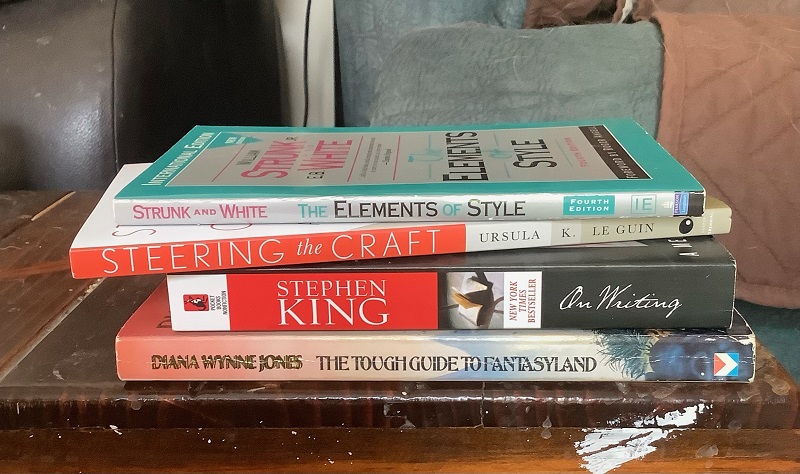
Over the years, I've picked up a few books on writing. King's On Writing was interesting, but as it was a couple of chapters of writing advice squished between two large slabs of memoir, it's not something I'm likely to re-read. Though The Tough Guide to Fantasyland isn't a guide to writing, exactly, it is still a fun exploration of all the tropes and clichés used in fantasy novels (though after you read it, you won't be able to stop picking apart every fantasy novel you try to read). I like it because it makes me think about which conventions of the genre to lean into and which conventions to avoid. 

A small stack of books on a wooden bench: The Elements of Style by Strunk and White, Steering the Craft by Ursula K Le Guin, On Writing by Stephen King and The Tough Guide to Fantasyland by Diana Wynne Jones.

By far the most useful writing book I had come across was Strunk and White's The Elements of Style. It focuses heavily on grammar and sentence structure, but also on conciseness and clarity. Reading it again recently has been useful for reminding me of the need for cutting out unnecessary fluff, and even a few rules of grammar I admit I'd forgotten.

A couple of weeks ago I stumbled upon a Reddit post asking for recommendations of books about writing. Some I'd already read after borrowing them from teachers or friends in my writing course, and hadn't found particularly useful, but there were a few that sounded promising. I decided to order Ursula K Le Guin's Steering the Craft as it was one of the most common recommendations, and it arrived yesterday.

I haven't had time to read it thoroughly yet, but from flicking through it, I can see that it looks like a useful companion book to The Elements of Style. While it also focuses on rules of language and grammar, it also provides example passages from existing literature that show these rules being applied (or in some cases, how the writing can be effective even if these rules are broken). Le Guin also provides several writing exercises or challenges throughout the book, which are useful at pushing you out of your comfort zone. I had a go at doing one of the exercises - where you have to explore two characters through dialogue alone, as if you were writing a film script, with no description or explanation - with a scene from my WIP. What came out isn't going to win any prizes, but it was useful in making me think more specifically about how to differentiate the characters' voices and avoid having everyone sound the same in their dialogue. If nothing else, it has helped me start to break down the wall between thinking about writing and actually writing.

Wednesday, August 14, 2024

When a loss is a win

While procrastinating the other day, I was messing around on the internet and stumbled across a thread on Reddit where a user was saying they had lost 20 pages worth of their book they were writing because of a Microsoft OneDrive problem, and that as a result they were giving up on writing because they'd "never be able to rewrite it as good as the original".

My initial reaction was to once again feel validated because of the large number of backups I make of my files. In addition to backing up to multiple cloud storage services, I also have backups on several physical storage media devices (USBs and external hard drives). While some folks might think I'm being anally retentive by having so many copies of my files, I've never lost more than about half a day's work, even with various file corruptions and hardware failures over the years.

Still, once I got over my moment of smugness, I remembered a 'data loss' incident I had during high school, though this was of the pen and paper variety. Back then, I did all my writing by hand, as I didn't have a computer. I would write rough drafts of my chapters on cheap notepad paper, and then once I revised them and was happy with them, I'd write the final version into an exercise book, which would then get passed around at school for my friends to read.

When I was about 10 or 11 chapters into that story, I lost the notepad drafts of my next chapter. After searching everywhere for several days, I became despondent, convinced that even if I rewrote it, it would be to a lower standard than the original. Eventually I realised that if I was going to finish the story, I had to rewrite that chapter, so I sat down and wrote out as much as I could from memory and then filled in the gaps with whatever I thought up at the time.

A few days after I finished the rewrite, I accidentally dropped the TV remote between our two armchairs, and when I fished it out, I also found the lost original draft of the chapter. At first I was elated that I hadn't lost my 'masterpiece', and I considered throwing away the new version I'd written, but then I decided to put them side by side and compare them.

Instead of being a pale imitation of the first draft, as I had expected, the second draft was significantly better than the original.

I suppose that after I'd written the first draft, the story and the ideas kept rattling around in my brain, so I was subconsciously still thinking about it and revising it. When I rewrote it, what came out was a more refined version. While I never ended up finishing that story, I do still sometimes find it useful, when a chapter or passage of what I'm writing isn't working, to put it away somewhere out of sight for a few days an then rewrite it from scratch. Often my subconscious seems to work on the problem while I'm doing other stuff, and by the time I rewrite it, many (if not all) of the issues I was struggling with end up being resolved in the second draft.

That being said, it's much less stressful to rewrite something from scratch because you chose to rather than because you lost the original, so I guess what I'm trying to say is...

Back up your shit.

Friday, July 26, 2024

Feelings of failure (and what I plan to do about them)

When I was young, I always knew I'd have some sort of day job in addition to whatever creative hobbies I pursued, but one expectation I had was that I would have a published book by the time I was 30, even if it was only released as a self-pubbed eBook. But my 30th birthday came and went (quite a few years ago) and not only had I not published anything aside from an illustrated children's book I made for an elective in my Honours year (which I published through Blurb as a PDF and printed book but which seems to have been removed from the site), but I hadn't even finished writing a single novel draft.

With my 40th birthday less than 2 years away, I can't help but feel that time is running out. That if I haven't finished a manuscript by that point I should give up on writing entirely. I know this isn't healthy, and I've been trying to avoid this self-destructive mindset (it's not just writing, but even with exercise and diet, I sometimes find myself thinking "Well, I failed this week, might as well not bother trying anymore") but as more time passes, I find it harder to feel confident that I can actually finish a story.

Then again, I look at how GRRM still hasn't finished The Winds of Winter even though he's ostensibly been working on it for 13 years. I figure if such an established and experienced author is having so much trouble finishing a book, then I shouldn't feel too bad about not finishing my manuscript yet after starting it in late 2010, especially since I spent the last decade dicking around doing a PhD.

Still, I don't want to end up in my rocking chair 40 years from now regretting that I never managed to complete a story, so I need to work out how to make sure that doesn't happen. I'm never going to be as prolific as someone like Stephen King, who sometimes cranks out multiple novels a year, but I can aim to at least finish my standalone novella, and then maybe one of the trilogies I've planned out.

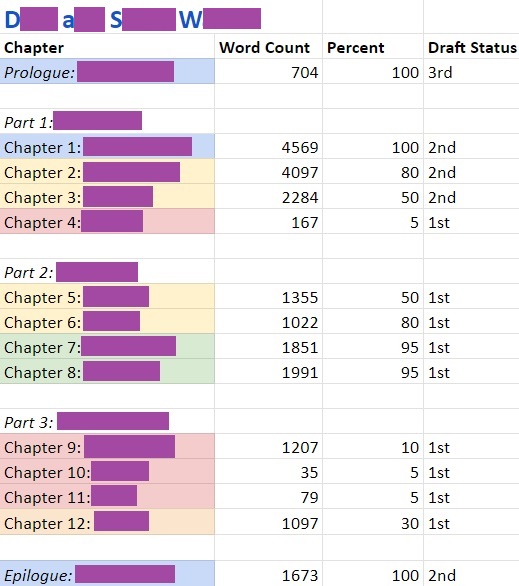
Now that I have my spreadsheet to track word counts and so on for each chapter, I'm hoping to be able to set more concrete goals for writing. As with my thesis tracking spreadsheet, I've colour-coded the chapters based on their state of completion. My brain seems to need a bit of visual help to comprehend things, so this should help me understand at a glance what I need to prioritise.

As mentioned in my previous post, I've got the start and end of the novella finished, and a small section of the middle more or less complete, but everything in between and either side of it is just fragments. Those complete or near-complete chapters can act as scaffolding for some aspects of the rest, but there are still quite a few plot points I need to resolve before I can connect all the chapters smoothly. This week I have been going through my manuscript and doing some edits, including changing some character names I didn't like (I thought they were cool when I came up with them more than a decade ago but re-reading them now makes me cringe) and tightening up a few waffly sentences.

In the past, I have tried setting daily word count goals, which has worked well for me for academic pieces such as literature reviews (as that's more of a slog through outlining work that's already been done) but not so much for writing stories (where you're essentially creating something out of nothing, something that has to be enjoyable to read as well as functional). In light of that, my strategy this time will be to set deadlines (eg. September 2024) to try to have a particular chapter draft finished. This will help me to have some focus without jumping around the entire novella but still give me some leeway in terms of how I put together each individual chapter. I'll see how that goes for a while, but if I don't make any significant progress, I'll try a weekly word count goal.

Anyway, it seems I will have a little more time for writing in the near future. I was expecting to get my thesis examination results sometime in the next week or two, but today I found out that one of my examiners has requested a one month extension. This means I won't hear anything for at least 5-6 weeks (if not more), so aside from spinning my wheels and keeping up with teaching work (which will also be relatively light until halfway through the semester, when assignments start coming in to be marked), I won't have much to do other than write.


Tuesday, July 23, 2024

Trying to get organised

Since my last post, I've mostly been preparing and revising teaching material for my classes, but I have also been making more of a concentrated effort to be creative. The first thing I did was block out time in my calendar each week, for art and for writing. One of the biggest challenges I had with writing was finding time to do it, as whenever a pocket of spare time presented itself to me, I'd always find an excuse or something else to do instead of writing. I didn't do a lot of writing this morning as I was recovering from yesterday's 8am class start time (I am decidedly not a morning person), but in the afternoon I have dug up a spreadsheet I started making several years ago with the structures and word counts for my WIP.

About a third of my chapters for that novella are complete or close to complete (pending any revisions once I get feedback on the drafts), another third are about half done and the final third have little to nothing written for them. Having numbers and charts like this helps me visualise progress - I found a similar spreadsheet useful for keeping track of progress on my PhD thesis chapters - and also see what needs to be done next. Between my word count totals and my chapter outlines, I'm hoping it will help me refamiliarise myself with my manuscript so I can start working on it again. After being forced to discontinue my PhD for almost 4 years, it took me a good 6-12 months to immerse myself in my research again and get to a point where I could move forward, but since I'm more interested in my novel than I was in that research project, I hope it won't take that long with my creative writing.

I've also been going over my outline for the chapters as well as the overall word counts. For the few chapters I've finished or almost finished (at the start and end of the book, with a few in the middle), I'm mostly happy with the contents, though there are still a few placeholder notes I wrote to myself more than a decade ago pointing out things that needed to be expanded or corrected but which I never got around to doing. But for the chapters that have almost nothing written in them, going back over the outline now reminds me why they have almost nothing written: because the outline for those chapters is either vague or contains events or plot points that are based on characters doing things Because The Author Needs Them To rather than because the character would logically or plausibly behave that way.

While I can continue refining the chapters that already have some substance, I think I am going to need to work out these plot kinks before I can make much progress on writing new material.

Sunday, July 21, 2024

Getting back on the writing wagon

I've been interested in writing for as long as I can remember. Even in grade 5, my teachers would groan when creative writing assignments would be due and I'd hand them a half full exercise book as opposed to the 1-2 page efforts submitted by my classmates. In high school I'd write my stories in larger exercise books and after I'd finished each chapter, would pass them around to my friends, who would read it and then give it back the following week, along with feedback and demands for me to hurry up and write the next bit.

After high school, I did a diploma in writing and editing, which I thoroughly enjoyed. My favourite classes were the creative writing workshops. Being able to get feedback (regardless of whether it was positive or negative) from other people who actually knew about writing was encouraging and helped me grow as a writer. After I finished that course, I swapped into a degree in Information Technology, and though I still fiddled with writing occasionally, I didn't write as often as I used to (though in the final year of my undergraduate, I did come up with the idea for my current WIP (a fantasy novella whose current title is taken from lyrics to a song that inspired the story, which means I'll need to change it at some point to avoid legal/copyright headaches; the initials of the title are DASW), which I worked on solidly for a few years, resulting in about 22,000 words of the story being written). Once I started my PhD, my writing slowed to a trickle and then eventually stopped altogether as I became too busy and burnt out from academia to do anything more creative than doodling on the notepads in my retail job.

Having finally submitted my thesis earlier this year, I've been trying to get back into writing, with the goal of actually finishing my WIP. So far it's been a colossal struggle; all I've managed is to open my outline or manuscript, stare at it blankly for a few hours and then close it again. It's a bit like picking up a video game you were halfway through when you haven't played it for several years; you can't remember what you were doing, so you don't know what you're supposed to do next. It also seems like all the writing communities I used to be active in back in the day have died; there was a hashtag on the birdsite called "ROW80" where people would see how many words they could write in stretches of 80 days, and while the hashtag used to act as a watercooler for writer folks to gather around, it mostly seems to have died off; in the last few years there are only a handful of posts with the hashtag, and they're pretty much all just links to blog posts rather than actual conversations. I used to also join in NaNoWriMo each November and briefly considered starting that again, but noped out of there quicksmart when I saw how problematic they had become (or maybe always were). I've tried finding other writing communities on emerging social media sites, but the ones I've come across either seem cliquey or like everyone is just shouting into the void without really engaging with one another.

Not having a group of other writers to engage with has made it a little harder for me to get back into writing, I think. That feeling of needing to 'update' other folks with my writing progress helped me to actually make progress, as it put pressure on me to write regularly so I would have something to write about in my blog posts. With that gone, I've decided to start writing this blog; even if no one reads it, I'm hoping that having something to post updates on will give me some incentive to start writing again and keep writing.

At this point I don't know how active I'll be on this blog (especially given semester 2 at uni starts tomorrow and I'm expecting to have to make some revisions to my thesis once it comes back from the examiners). Some might think I'm using it as a tool to procrastinate from doing actual work (and they'd probably be right). If I do keep finding useful things to put on it and people actually start reading it and finding it interesting, I may move the blog to WordPress (either as its own blog or merge it with my existing art blog) and put my actual name on it, but for now it's just somewhere for me to ramble about my writing (or lack thereof).

DASW Word Count: 22,131